ADVERTISEMENTS
- Innovative concept and phenomenal performance redefine the pinnacle of the super sports car segment
- Entirely new technology package, unique and powerful functional design language
- Innovative carbon-fiber monocoque
- New twelve-cylinder engine with 515 kW / 700 hp
- Super-fast shifting ISR (Independent Shifting Rods) transmission
- Pushrod suspension
- The very finest equipment and trim, extensive individualization
With the Aventador LP 700-4, Automobili Lamborghini is redefining the very pinnacle of the world super sports car market – brutal power, outstanding lightweight engineering and phenomenal handling precision are combined with peerless design and the very finest equipment to deliver an unparalleled driving experience. With the Aventador, Lamborghini is taking a big step into the future – and building on the glorious history of the brand with the next automotive legend. The first customers will take delivery of the new Lamborghini Aventador LP 700-4 in late summer 2011.
The technology package of the Lamborghini Aventador LP 700-4 is utterly unique. It is based on an innovative monocoque made from carbon-fiber that combines exceptional lightweight engineering with the highest levels of stiffness and safety. The new twelve-cylinder with 6.5 liters’ displacement and 515 kW / 700 hp brings together the ultimate in high-revving pleasure with astonishing low-end torque. Thanks to a dry weight of only 1,575 kilograms (3,472 lb), which is extremely low for this class of vehicle, the weight-to-power ratio stands at only 2.25 kilograms per hp (4.96 lb/hp). Even the fantastic 0-100 km/h (0-62 mph) acceleration figure of just 2.9 seconds and the top speed of 350 km/h (217 mph) do not fully describe the Aventador’s extreme performance. And yet, fuel consumption and CO2 emissions are down by around 20 percent compared with its predecessor, despite the considerable increase in power (+8%).
The ISR transmission is unique among road-going vehicles, guaranteeing the fastest shifting time (only 50 milliseconds) and a highly emotional shift feel, while the lightweight chassis with pushrod suspension delivers absolute handling precision and competition-level performance. The expressively-designed interior offers hi-tech features ranging from the TFT cockpit display with Drive Select Mode system. The Aventador will be built to the very highest quality standards in an all-new production facility in Sant’Agata Bolognese.
“With the Aventador LP 700-4, the future of the super sports car is now part of the present. Its exceptional package of innovative technologies is unique, its performance simply overwhelming,” says Stephan Winkelmann, President and CEO of Automobili Lamborghini. “The Aventador is a jump of two generations in terms of design and technology, it’s the result of an entirely new project, but at the same time it’s a direct and consistent continuation of Lamborghini’s brand values. It is extreme in its design and its performance, uncompromising in its standards and technology, and unmistakably Italian in its style and perfection. Overall, the dynamics and technical excellence of the Aventador LP 700-4 makes it unrivalled in the worldwide super sports car arena.”
Aventador: the name of one of the most courageous of all bulls
According to its tradition, Lamborghini’s new flagship bears the name of a bull – naturally, a particularly courageous specimen from the world of the Spanish Corrida. Aventador was the name of a bull that entered into battle in October 1993 at the Saragossa Arena, earning the “Trofeo de la Peña La Madroñera” for its outstanding courage.
A sculpture of extreme dynamics
For Lamborghini, design is always the beauty of aggressive power, the elegance of breathtaking dynamics. From the very first glance, the new Aventador is unmistakably a Lamborghini, clothed in the brand’s characteristic and distinctive design language – with its extremely powerful proportions, its exact lines and precise surfaces, and with taut muscularity in every one of its details. The designers in the Centro Stile Lamborghini have carefully developed this design language to give the Aventador a significant new edge. It is an avantgarde work of art, an incredibly dynamic sculpture, from the sharply honed front end through the extremely low roofline to the distinctive rear diffuser. Every line has a clear function, every form is dictated by its need for speed, yet the overall look is nothing less than spectacular and breathtaking.
The doors open upward – of course
Truly impressive proportions come from an overall length of 4,78 meters (188.19 in.) matched with an impressive width of 2,26 meters (88.98 in.) including the exterior mirrors, and further accentuated by an extremely low height of just 1.136 mm (44.72 in.). It goes without saying that both doors of the carbon-fiber monocoque open upward – a feature that was first introduced in the now legendary Countach and then used for subsequent V12 models such as Diablo and Murciélago. However, the Aventador also evokes its immediate predecessor the Murciélago – electronically managed air intakes open depending on the outdoor temperature and the need for cooling air,ensuring maximum aerodynamic efficiency. And for those whishing to flaunt the heart of their Lamborghini, the optional transparent engine bonnet exhibits the twelve-cylinder engine like a technical work of art in a display case.
Exclusive and high-tech interior
The Aventador’s spacious interior combines the fine exclusivity of premium materials and perfect Italian craftsmanship with state-of-the-art technology and generous equipment. The red switch cover on the broad center tunnel encloses the start button used to awaken the twelve-cylinder. The interior is dominated by a next-generation dashboard – as in a modern airplane, the instruments are presented on a TFT-LCD screen using innovative display concepts. A second screen is dedicated to the standard-fit multimedia and navigation system.
Carbon-fiber monocoque
The new Lamborghini flagship has a full monocoque. The entire occupant cell, with tub and roof, is one single physical component. This ensures extreme rigidity and thus outstanding driving precision, as well as an extremely high level of passive safety for the driver and his passenger. The entire monocoque weighs only 147.5 kilograms (325.18 lb).
The monocoque, together with the front and rear Aluminium frames, features an impressive combination of extreme torsional stiffness of 35,000 Newton meters per degree and weighs only 229.5 kilograms (505.9 lb).
Maximum revs, amazing sound
For the Aventador LP 700-4, the engineers in Lamborghini’s R&D Department have developed a completely new high-performance power unit – an extremely powerful and high-revving, but very compact power unit. At 235 kilograms (518 lb), it is also extremely lightweight. A V12 with 515 kW (700 hp) at 8,250 rpm sets a whole new benchmark, even in the world of super sports cars. The maximum torque output is 690 Newton meters (509 lb-ft) at 5,500 rpm. The extremely well-rounded torque curve, the bull-like pulling power in every situation, the spontaneous responsiveness and, last but not least, the finely modulated but always highly emotional acoustics are what make this engine a stunning power plant of the very highest order.
Innovative transmission for maximum performance
Engineers at Lamborghini have created the perfect mate for the new twelve-cylinder engine with the highly innovative ISR (Independent Shifting Rods) transmission. The development objective was clearly formulated – to build not only the fastest robotized gearbox, but also to create the world’s most emotional gear shift. Compared with a dual-clutch transmission, not only is the ISR gearbox much lighter, it also has smaller dimensions than a conventional manual unit – both key elements in the field of lightweight engineering for super sports cars.
Refined and safe with all-wheel drive
This kind of extreme power must be delivered reliably to the road. The driver of the Aventador LP 700-4 can depend fully on its permanent all-wheel drive – indicated by the 4 in the model designation. In the driveline, an electronically controlled Haldex coupling distributes the forces between front and rear. In a matter of milliseconds, this coupling adapts the force distribution to match the dynamic situation. A self-blocking rear differential together with a front differential electronically controlled by ESP make for even more dynamic handling. The Drive Select Mode System enables the driver to choose vehicle characteristics (engine, transmission, differential, steering and dynamic control) from three settings – Strada (road), Sport and Corsa (track) – to suit his individual preferences.
Pushrod suspension
Lamborghini has equipped its new V12 super sports car with an innovative and highly sophisticated suspension concept. The pushrod spring and damper concept was inspired by Formula 1 and tuned perfectly to meet the needs of a high-performance road-going vehicle. Together with aluminum double wishbone suspension and a carbon-fiber ceramic brake system, this lightweight chassis represents a further aspect of the new flagship’s unique technology concept.
Extensive assistance and safety systems
In the hands of its driver, the Lamborghini Aventador LP 700-4 is a high-precision machine – spontaneous, direct and always reliable. The driver is also assisted by the latest electronic systems such as the incredibly sporty, adjustable ESP system. When it comes to passive safety, front, head-thorax and knee airbags play their part alongside the extremely stiff carbon-fiber cell.
A rich and wide-ranging individualization program
A Lamborghini should always fit perfectly with the style and preferences of its owner. To this end, the range of individualization options is virtually inexhaustible. There is a selection of 13 production paint colors to choose from, three of which are highly sophisticated matt tones. A choice of two-tone interiors are offered with the “Sportivo” and “Elegante” versions, while a premium audio system and reversing camera are among the many technology options. And of course, the “Ad Personam” individualization program knows no limits when it comes to colors and materials.
2. The Design
Every Lamborghini is an avantgarde work of art, a fast-moving technical sculpture. Every line, every detail of a super sports car from Sant’Agata is derived from its function – namely speed, dynamics, performance. Every Lamborghini is a purist’s dream, reduced to its very essence.
With the new Aventador LP 700-4, the designers at the Centro Stile Lamborghini in Sant’Agata Bolognese have taken this committed philosophy to a whole new level – its extreme, razor-sharp lines portray a precision that is without parallel in automotive design. And its clean, taut and expertly executed surfaces demonstrate the exceptional competence and depth of experience possessed by Lamborghini in carbon-fiber body shell design.
The surface of the roof has a new geometry that provides greater spaciousness for the passengers while at the same time giving relief to the lines of the front section.
This also addresses the aim of obtaining a better aerodynamic coefficient, continuing Lamborghini’s design philosophy of ‘form follows function’.
The engine cover utilizes the same styling giving continuity to the concept.
Inspiration from aeronautics
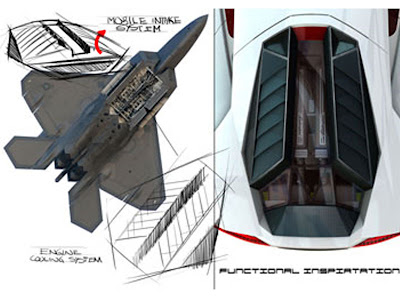
For the further development of the Lamborghini design language, designers pulled their inspiration from another sphere dominated by speed and dynamics – from modern aeronautics, from the world’s fastest and most agile aircraft. This gave rise to a design of maximum functionality and spectacular sharpness, an extremely precise and highly technical design language with a new kind of vitality. Powerfully defined lines and taut surfaces create a fascinating interplay of light and shade, endowing the car with tremendous visual movement. The limited edition Reventón – a work of automotive art – and the Sesto Elemento ‘technology demonstrator’ were forerunners of this philosophy: the Aventador is the first Lamborghini series production car embodying this vision.
The Aventador, of course, also follows the mid-engine concept, with the vehicle weight concentrated around the vertical axis to reduce inertia and optimize dynamics. With the legendary Countach, Lamborghini was a pioneer of mid-engine construction, its revolutionary concept bringing racing technology to the road. The design of the Aventador adds visual emphasis to the mid-engine layout, with a look that concentrates its power on the rear axle.
Aerodynamic efficiency is crucial
For such an extremely powerful automobile, the most crucial task of the body shell design is aerodynamic efficiency: the optimum airflow for absolute stability at all speeds and, at the same time, optimum cooling for the engine. On the Aventador, all aerodynamic elements are integrated into the body shell form, from the front spoiler to the rear diffuser. A key role is played by the flat, optimized underbody. The rear spoiler is deployable and controlled electronically. At rest, it lies flush with the rear of the vehicle; in operation, it has two positions – the approach angle of 4 degrees is optimized for high speed and assists directional stability at the very top end of the spectrum. The tilt of 11 degrees, on the other hand, delivers considerably greater downforce at mid-range speeds, helping to optimize handling and stability. The car uses dynamic parameters to calculate for itself the most appropriate tilt angle.
Impressive proportions, mighty air intakes
The first striking impression of the Aventador focuses on its proportions. At a length of 4.78 meters (188.19 in.), it is a truly impressive 2.26 meters (88.98 in.) wide including exterior mirrors, but only 1,136 meters (44.72 in.) high. The impression of width is further emphasized by the widely spaced air intakes and headlamp units.
The Aventador’s incredibly low front takes on a distinct arrow form, with the Lamborghini bull insignia gracing both the point and the center line, which continues its path along the entire length of the vehicle. The air guides are powerfully profiled and further emphasized by their glossy, black frames. The bi-xenon headlamps are clustered with the LED units for daytime running lights and indicators beneath hexagonal casings. The daytime running light comes from LED light guides that wrap around the main headlamp in a Y form. Seven further LEDs provide the light source for the indicator.
Two strokes define the side line
The extremely long side view is dominated by the very low roofline and by two sweeping strokes – the first emphasizes the front wheel arch; the second, very sharply drawn line begins at the front wheel arch and runs like a tensed muscle along the entire side of the car and over the rear wheel. The deeply recessed door and the mighty sill bear further testimony to the determined functionality of the Lamborghini design. Ultimately, these forms serve only one purpose – to deliver the maximum volume of cooling air to the mighty V12 power plant. The large air intakes behind the upward-opening doors are also enclosed in black plastic frames and guarded by a fine mesh. The engine air intake is located on the roof pillar, behind the third side window. And when cooling requirements are particularly high, additional air channels open up on the rear wheel arches.
The rear end, too, is dominated by openings framed in black, where the hot air finds its exit. The entire rear end is highly three-dimensional in its design. The lower diffuser stands in powerful relief, while the substantial format of the hexagonal tail pipe symbolizes the concentrated potency of the engine. The rear lights in LED technology reiterate the triple Y motive already familiar from current Lamborghini models.
V12 as an object of technical beauty
Equally familiar is the transparent engine bonnet (option), which adds a particularly attractive dimension to the many emotional perspectives on the Aventador. The twelve-cylinder power unit, with its mighty black intake manifold, lies in all its technical glory beneath the three cover panels. It is framed by diagonal carbon-fiber struts and accompanied by the powerful dampers from the pushrod suspensions.
The design philosophy continues into the surprisingly roomy interior. The cockpit is upholstered entirely in fine leather and also takes on a subtle arrow form. The controls are logically grouped on the broad center console. Here, too, the inspiration derived from aviation is immediately apparent – as in modern aircraft, the instruments are presented on a TFT-LCD screen. At the center of the display is a large dial – at the touch of a button, the driver can choose whether he would rather see the road speed read-out or the engine speed. Further information ranging from fuel level to the output from the on-board computer is grouped in fields surrounding the large dial.
The operating system
The most important switch is hidden beneath a red switch cover – the start button, which instantly fires the high-performance engine into life.
A second, seven-inch TFT-LCD screen in the center console belongs to the integrated multimedia system. Beneath it is the familiar array of Lamborghini toggle switches for operating functions such as the electric windows or the front axle lifting system, as well as the controls for the air conditioning.
The Lamborghini Aventador LP 700-4 offers a state-of-the-art and comprehensive lineup of electronic vehicle, entertainment and communication systems. These functions are operated in a clear and intuitive manner via the Human-Machine Interface (HMI) on the center console, featuring a large push/turn control and eight function keys.
3. The carbon-fiber monocoque of the Lamborghini Aventador
Lamborghini is heading into the future with a systematic lightweight design concept – the intensive application of carbon-fiber materials forms the key foundation for the extreme dynamics of the new Aventador LP 700-4. The new flagship is based on a full monocoque construction made with these innovative materials – conceived and produced entirely by Automobili Lamborghini in Sant’Agata Bolognese.
This development sees Lamborghini once again demonstrate its worldwide leading expertise in carbon-fiber technology. The super sports car brand from Sant’Agata Bolognese is the only automaker to have fully mastered the extensive CFRP process across a range of technologies in-house – from 3D design, through simulation, test, production and validation using state-of-the-art industrial processes to the very highest quality standards. With the Aventador, Lamborghini is putting its innovative, in-house developed and patented technologies into series production for the first time.
The cell of the future Lamborghini flagship super sports car is made entirely from carbon fiber and has been designed as a monocoque structure. The load-bearing structure of the vehicle is engineered as a “single shell” that functions physically as one component, thus taking full advantage of the extreme rigidity of CFRP. Formula 1 race cars have been built using CFRP monocoques for many years – and have proven their crash worthiness time and again. The same applies to road-going sports cars featuring monocoque technology – the carbon fiber occupant cell functions like an extremely safe roll cage.
Construction offers many advantages
Of course, the term “single shell” applies only in the descriptive sense – the new Lamborghini monocoque is made from a series of individual parts with specific functions and technologies, such as stiffening elements made from Braiding technology, that is one of the best technology to manage energy adsorption in case of crash. After the curing process, however, this structure functions as a single component – including the base section known as the tub and the complete roof.
The full monocoque solution offers advantages which other processes, like a tub where a metal roof structure is attached in a conventional manner, cannot realize. That’s why Lamborghini made the no compromise choice of the full monocoque, which weighs only 147.5 kilograms (324.5 lbs).
Extremely rigid construction
Superior passive safety is only one benefit of the extreme rigidity of a full carbon fiber monocoque - very high torsional rigidity is another. The monocoque is connected at the front and rear with equally rigid aluminum sub-frames, on which the suspension, engine and transmission are mounted.
The entire body-in-white of the future V12 model weighs only 229.5 kilograms (505 lbs) and boasts phenomenal torsional rigidity of 35,000 Newton meters per degree of twist. This guarantees a superb feeling of solidity, but, more importantly, extremely exact wheel control with excellent steering precision and sensitive feedback. For the dedicated driver, both are essential for truly enticing driving pleasure. The new Lamborghini flagship responds to the most minute steering input with the stunning precision of a perfectly balanced race car.
Depending on the form, function and requirements of the individual elements, the Lamborghini development team selected from three main CFRP manufacturing methods within its technology tool kit. They differ not only in their production processes, but also in the type of carbon fiber and its weave and, most importantly, in the chemical composition of the synthetic resin used.
Resin Transfer Moulding (RTM): In this process the carbon fiber mats are preformed and impregnated with an exact amount of resin. Afterwards, they are cured under heat while the part is in the mould. Lamborghini has achieved a major breakthrough by further developing this method. Using the patented “RTM-Lambo” process, the final mould is no longer a heavy, complex metal piece, but is made instead from lightweight carbon-fiber parts, thus making the manufacturing process faster, more flexible and more efficient.
An additional benefit of the RTM-Lambo process is the low injection pressure that doesn’t require expensive equipment.
Prepreg – The carbon fiber mats used in this method, commonly known as prepreg, are pre-injected by the supplier with a thermosetting liquid resin and must be stored at a low temperature. The mats are then laminated in molds and cured under heat and pressure in an autoclave. Prepreg components are complex to make, but have an extremely high-quality surface finish (Class-A surface quality) and are therefore the preferred option for use in visible locations.
Braiding – These components are manufactured by using RTM technology. This carbon fiber weave technology is derived from the textile industry and used to make tubular components for special applications such as structural roof pillars and rocker panels. The woven components are made by diagonally interweaving the fiber in several layers.
The monocoque of the new V12 super sports car is constructed using these technologies applied in a series of special processes. One significant advancement Lamborghini realized is the ability to use already-assembled monocoque elements as the mould for the next step in the process. This makes for a considerable simplification of the manufacturing process compared with conventional methods.
Epoxy foam components are also used within the monocoque. They are placed in strategic points to increase the stiffness of the monocoque by working as spacers between the composite layers while also dampening noise and vibration. In addition, aluminum inserts are laminated into the front and rear surfaces to facilitate connection with the aluminum front and rear sub-frame elements.
Because of the complexity of the materials and process outlined above, Lamborghini decided to produce its new monocoque completely in-house, managing one strategic step in the production process.
Quality control is an absolutely crucial factor – every single monocoque is measured to exacting tolerances of only 0.1 millimeters, facilitating the extreme precision of the overall vehicle. Quality control starts with the purchase of the carbon fiber parts. Every delivery of carbon fiber is certified and the material is checked regularly for compliance with quality standards. Lamborghini worked together with its suppliers to develop a world-exclusive fiber and resin system for its RTM technology. Ultimately, these materials and processes constitute an important part of Lamborghini’s worldwide leading expertise in the field.
Carbon composite materials - A key technology for tomorrow’s high-performance automotive engineering
These materials made from CFRP combine the lowest possible weight with excellent material characteristics – they are very light, extremely rigid and exceptionally precise.
Furthermore, CFRP materials can also be formed into highly complex components with integrated functions. This reduces the number of individual parts when compared to traditional metal construction – thus enabling further weight reduction. Lighter cars have lower fuel consumption and fewer CO2 emissions. Most significantly, however, it improves the power-to-weight ratio – the deciding factor in the overall feel and performance of a sports car. A super sports car built using CFRP accelerates faster, has superior handling and better braking.
4. The new V12 power unit –
the heart of the Lamborghini Aventador LP 700-4
The twelve-cylinder is the king of the engine world and the true heart of the Lamborghini brand. The very first model created by Feruccio Lamborghini, the 350 GT, made its appearance in 1964 featuring a twelve-cylinder engine that was incredibly innovative for its day. 3.5 liter displacement and 320 hp were the vital statistics back then – they formed the basis for ongoing increases and further development over the decades that followed. Miura, Espada, Countach, Diablo and, finally, Murciélago are just a few of the super sports cars born in Sant’Agata. All of them were, and will continue to be, driven by V12 engines – and all have long since risen to the status of automotive legend.
Now the next milestone in this glorious history appears – engineers in the Lamborghini R&D Department have developed a completely new high-performance power unit. That it would be another twelve-cylinder was never in doubt - and not only because of the special magic conjured up by the number twelve. The only real choice for Lamborghini is a high-revving naturally aspirated engine – the deeply reflexive and exceptionally powerful reaction of the automobile to the tiniest movement of the driver’s right foot is, of course, a key part of the whole fascination inspired by a super sports car. Ten cylinders are ideal in the displacement class around the five liter mark, as evidenced by the highly acclaimed Gallardo engine. For the 6.5 liter displacement targeted in this case, the perfect number is twelve. A lower number of cylinders would result in larger and heavier pistons and con-rods, which would have a negative impact on the engine’s high-revving characteristics.
Starting with a clean sheet of paper
The specification for the development of the new twelve-cylinder, known internally as the L539, was written quickly – yet was highly demanding in its formulation. Naturally, it had to deliver more power and torque than its predecessor in the Murciélago, but it should also be smaller and lighter and enable a lower center of gravity. At the end of the day, low weight is just as important to the performance of a super sports car as high power output. Fuel consumption and gas emissions should also be reduced significantly.
So the R&D team started with a clean sheet of paper – metaphorically speaking, of course. Design and development in Sant’Agata is conducted using state-of-the-art systems and equipment. The outcome is a V12 with a classic cylinder bank angle of 60 degrees, and thus an amazingly compact power package – the power unit measures only 665 millimeters from top to bottom, including the intake system. Its width, including the exhaust manifold, is only 848 millimeters, while its length is a mere 784 millimeters. Its weight of 235 kilograms is also respectably low – each kilogram of engine weight corresponds to 3.0 HP maximum output.
Optimized for high revving and low weight
The crankcase on the new power plant is made from an aluminum-silicon alloy and has an open-deck construction with steel cylinder liners. Displacement is 6,498 cm3 and cylinder spacing 103.5 millimeters, while bore diameter measures 95 millimeters and stroke 76.4 millimeters. The short-stroke layout is especially good for high-revving characteristics and for low internal friction. Particular attention was also paid to the bearings for the forged and nitride-hardened crankshaft, which weighs in at 24.6 kilograms.
The two four-valve cylinder heads are likewise made from sand-cast aluminum-silicon alloy, each weighing a very light 21 kilograms. The twelve pistons and con-rods are, respectively, in forged alloy and steel. The maximum piston speed at 8,250 rpm is only 21 meters per second, which is considerably less than for the Murciélago’s previous power unit. The combustion chambers were carefully engineered to achieve optimum tumble and combustion of the fuel/air mixture. At 11.8:1, the compression ratio is extremely high. Inlet and outlet valve timing is electronically controlled.
Sophisticated thermal management, optimized oil circulation
The thermal management of this high-performance power unit was perfected with extensive detail engineering. Two switchable water circuits in the engine ensure very rapid warm-up, which minimizes friction and quickly brings the catalytic converters up to operating temperature, thus benefiting fuel consumption and emissions. The external water coolers are switched into the circuit only as required.
Absolute engine health, even under extreme racetrack conditions with high lateral acceleration, is guaranteed by oil circulation using a dry sump system. A total of eight scavenger pumps suck oil out of the lower bedplate fastened to the crankcase. Pressure and scavenging losses are thus reduced by around 50 percent. A high-pressure oil pump maintains lubrication, while an oil/water cooler and an oil/air radiator constantly keep temperatures within range even under extremely high load. A further benefit of this form of dry sump lubrication is the very low mounting position of the engine within the sports car. The new engine is mounted 60 millimeters lower than the V12 in the Murciélago – with the associated benefits in respect of center of gravity and lateral dynamics.
From the outside, the V12 is dominated by its intake system – which incorporates four individual throttle valves. Life inside the black housing is also extremely complex – the optimum intake path for any given load and engine speed is facilitated by two flaps, several channels and one bypass. The payback is an extremely well-rounded torque curve and refined pulling power throughout the rev range.
Mighty orchestra for twelve voices
The exhaust system, too, was afforded the undivided attention of Lamborghini’s engineers – the lowest possible gas emissions was just as important a target as the unmistakable, spine-tingling Lamborghini sound. The hydro-formed and thermally insulated three-into-one system incorporates four pre-catalytic converters close to the engine and two main catalytic converters shortly before the muffler. The casing incorporates two separate mufflers – one low-volume, one high-volume. Regulated by valves controlled via the engine management, they handle all the elements of the big twelve-cylinder symphony – from a moderate rumble when rolling through the city at low revs to the screaming crescendo of maxed-out gear shifts.
Electronics devised entirely by Lamborghini
Another highlight is the electronic engine management, which was developed in its entirety by engineers at Lamborghini. The system consists of the main ECU, a secondary “smart actuators” and two additional black boxes that function as “smart sensors”. Because speed is everything for an engine like this, some ECU control and connection functions are handled by the smart actuators, making the ECU faster. The two smart sensors are constantly monitoring combustion in real time – each ignition in every cylinder. The spark plugs – each is powered by an individual ignition coil – function as “sensors”; the two auxiliary control units monitor the power signal after every ignition and can immediately identify irregularities in the combustion process through ionization phenomena. This data is used to continually optimize engine management, benefiting both performance and fuel consumption.
High performance in every dimension
All these technical highlights come together to create a high-performance power unit like no other. The maximum output of 515 kW (700 hp) at 8,250 rpm is an impressive statement in itself. The maximum torque is 690 Newton meters and is available at 5,500 r/min. The extremely generous torque curve, meaty pulling power in every situation, extremely reflexive responses and, not least, the finely modulated but always highly emotional acoustics make the L539 a stunning power unit for a super sports car of the highest order. And not only was the L539 developed entirely in-house at Lamborghini, it is also built from start to finish at company headquarters in Sant’Agata Bolognese. Highly qualified specialists assemble the engines by hand, with every single unit undergoing an extensive final testing and detailed calibration program on an engine test bed.
The new Lamborghini ISR transmission (ISR: Independent Shifting Rods) - Innovative servo-actuated mechanical gearbox for maximum performance
However, it is not the engine alone that defines the character and driving characteristics of a super sports car. Another key element is the transmission. The demands are clear – the ratios must be perfectly arrayed and enable optimum power delivery from the engine. For maximum vehicle performance, shift times should be less than the blink of an eye. Operation must be clear and straightforward, via two ergonomic shift paddles behind the steering wheel. The characteristics of the transmission must be in line with the wishes of the driver at any given point – from smooth city cruising through to tough action on the racetrack. And, not least, Lamborghini customers expect an emotional shift feeling that ensures the sports car’s reactions can always be felt and understood. Thus, the development objective was clearly formulated in this respect, too – create the world’s most emotional gear shift.
For all these reasons, the engineers in the R&D Department opted for a robotized gearbox as the “companion” of the new V12 power unit – however, in a very special iteration: the Lamborghini ISR transmission. This important part of the powertrain is not only much lighter in comparison to a dual clutch transmission, it also has the compact dimensions of a regular manual gearbox. Both weight and size advantages are key in the process of building super sports cars.
Unique engineering for super sports cars
The new unit is laid out as a two-shaft transmission with seven forward gears and one reverse. For especially high durability, the synchronizing rings are made from carbon-fiber – a material with which Lamborghini has enormous experience. The short shift times are facilitated by the special design of the transmission, known as ISR – Independent Shifting Rod.
To summarize the principle – in a conventional manual gearbox, be it automated or fully manual, the gear wheels for, say, second and third gears are located side by side. When the driver wants to shift gear, the shifting sleeve with synchronizer unit is moved along the shifting rod from second gear through neutral to third gear. This requires twice the distance and twice the time – second gear has to be disengaged before third gear can be engaged.
Short distances, fast shift times
This process is significantly shortened in the Lamborghini ISR transmission – the gear wheels from the second and third gears are separate from each other and the shifting sleeves are actuated by independent shifting rods. Now the shifting process can run virtually in parallel – while one shifting rod is disengaging one gear, the second shifting rod can already engage the next gear. Because these movements partially overlap and the mechanical distances are considerably shorter, this facilitates a significant saving in shift time. Overall, the Lamborghini ISR transmission shifts around 140 percent faster than the e.gear transmission in the Gallardo. And that is already one of the world’s fastest automated manual gearboxes.
Compact construction, low weight
The new transmission has four of these independent shifting rods, with sensors constantly monitoring their exact positions. They are operated via hydraulic actuators, with an extremely high system pressure of 60 bar ensuring the necessary operating speed. The system incorporates a total of seven hydraulic valves, with pressure supplied by an electric pump. The double-plate clutch is also hydraulically actuated. All system components are contained within one casing. The total weight of the transmission is only 70 kilograms – a distinct advantage, especially compared with the significantly heavier seven-gear dual-clutch transmissions.
Five operating modes for all situations
Lamborghini drivers can choose between five operating modes: three manual (Strada, Sport and Corsa) and two automatic (Strada-auto and Sport-auto). The Strada mode offers highly comfort-oriented shifting, with fully-automatic also an option. The Sport mode has a dynamic set-up in terms of shifting points and times, while the Corsa mode delivers the maximum shift strategy for race track driving. This mode also includes Launch Control, the automatic function for maximum acceleration from a standing start.
With the Lamborghini ISR transmission, engineers working under the sign of the bull have devised an ingenious mate for the new twelve-cylinder power unit. Their work has created an overall powertrain that is absolutely unique in the world of super sports cars.
Integrated electronic control system
The excellent performances are possible only by a fast communication architecture through the several powertrain ECU’s and considering the powertrain as ONE-system in the car.
The fully electronic controlled coupling device for the front wheels (the ‘old’ viscous coupling) is another key point of the powertrain: it is able to continuously distribute the right torque to the front wheels for always attaining the best performance aspired to by the driver. The torque distribution to the front wheels can vary continuously from 0% to 60% of the total torque available.
5. Pushrod suspensions and steering
The new Lamborghini V12 super sports car features an innovative and highly sophisticated suspension concept. The pushrod spring and damper concept was inspired by Formula 1 and tuned perfectly to meet the needs of a high-performance road-going vehicle. Together with aluminium double wishbone suspensions and a carbon ceramic brake system, this lightweight chassis is another element of the unique technology concept in Lamborghini’s new flagship model.
An extremely precise, indeed razor-sharp, driving feel accurately describes the soul of the newest and most powerful super sports car ever to bear the sign of the bull. This includes a steering system that can think its way through a bend adhering to the perfect line, a suspension that masters the ideal balance between race-car feel for the road and plenty of comfort for ramping up the miles, and lateral stability that ensures absolute safety even at the very highest speeds.
Pushrod suspension derived from motorsport
With its phenomenal engine output of 515 kW / 700 hp and its comparatively low vehicle weight, the new V12 super sports car from Lamborghini blasts its way to the very highest speeds. The most important characteristic of the new suspension is its design in line with the pushrod principle – inspired by Formula 1. The spring/damper elements are not located on the wheel mounts, but connected inboard to the body shell structure. They are transversely positioned: under the windscreen in the front and close to the engine in the rear. Pushrods and relay levers / rockers transmit the forces from the wheel mounts to the spring/damper elements.
Responsive handling characteristics at all speeds
This solution offers a whole series of impressive benefits: due to the combination of the double wishbone and pushrod arrangement, wheel control and damper remain separate from each other. As a result, handling is more responsive and easier to manage at all speeds, while rigid connection to the chassis also improves the precise and spontaneous reaction of the springs and dampers. As a result, spring stiffness can be notched back a little – comfort increases, while precision remains. On the front axle, the shock absorbers are equipped with a hydraulic lifting system, which enables the front end of the super sports car to be lifted by 40 millimeters at the touch of a button, simplifying its ability to negotiate minor obstacles.
Systematic lightweight engineering in aluminum and carbon fiber
Aluminium and carbon fiber are also the most important lightweight engineering materials on the chassis. The entire suspension system, including upper and lower control arms, wheel mounts and relay levers are made from forged aluminium alloy. The large-diameter discs on the high-performance brake system, on the other hand, are made from lightweight and extremely hard-wearing carbon ceramic composite material. On the front axle, the ventilated discs measure no less than 400 millimeters in diameter, with braking force delivered via six cylinder calipers. On the rear axle, 380 millimeter diameter discs are used in combination with four cylinder calipers. The parking brake on the new Lamborghini top model is electrically powered.
Steering forms the sensitive connection between driver and automobile
The hydraulic steering on the Lamborghini V12 forms the highly sensitive connection between the driver and the super sports car, which runs on 19-inch wheels clad on 255/35 tires at the front and 20-inch rims on 335/30 tires at the rear. Steering Gear foresees 3 different servotronic characteristics managed by drive select mode.
6. Equipment and Options
The new Lamborghini Aventador LP 700-4 offers the most up-to-date, comprehensive and individualistic technology and equipment package ever realized in a super sports car. From the dynamics through safety to communication and entertainment, the Aventador fulfills every imaginable desire of the most demanding sports car fan. The wide range of exterior and interior colors and variants is perfect for individualization and, of course, “Ad Personam” is also available for the Aventador for the ultimate in personalization – where the only limits set are those of the imagination.
The standard package of electronic systems includes ABS, electronic brake distribution, anti-slip control, speed-dependent servo-tronic steering, hill start assist and, of course, ESP stability control. The rear spoiler and the side air intakes are electronically controlled. The Drive Select System enables vehicle characteristics (engine, transmission, differential, stability control, steering) to be set in accordance with individual driver preferences in one of three modes – Strada (road), Sport and Corsa (track).
Latest Generation HMI control
The cockpit with TFT-LCD display also comes as standard, as does the multimedia HMI system with Navigation, including traffic data, iPod connection and Bluetooth.
The automatic climate control functions with a sunlight sensor, with further sensors controlling the automatic headlights. The bi-xenon headlamps come with daytime running lights and rear lights in LED technology.
The five-spoke alloy wheels are clad in Pirelli P Zero tires and feature tire pressure monitoring, while the brake system is equipped with carbon-ceramic rotors and black brake calipers. Safety equipment includes six front, thorax, head and knee airbags.
Wide range of individualization options
Options include features such as the transparent engine cover, black painted wheels and brake calipers in yellow, gray or orange. The standard audio system can be upgraded to the “High-End Lamborghini Sound System” with premium speakers featuring neodymium technology and 4 x 135 watt amplifiers. Park assistance systems include proximity sensors front and rear, as well as a reversing camera.
A range of 13 colors are available at launch, in pastel metallic, pearlescent or matt finishes. These include the new shades Grigio Estoque and Arancio Argos. Three colors are available in specialized and highly sophisticated matt finishes as AD Personam– Nero Nemesis, Bianco Canopus and Marrone Apus.
The full leather single-color interior is available in either Nero Alde (black) or in Marrone Elpis, a warm brown shade. The contrasting stitching can be ordered in a range of colors. The two-tone leather interiors are offered in two style lines. For Bicolor Sportivo, the base color is black, with the contrast in orange, white, yellow or green, while Bicolor Elegante presents a harmonious blend of brown tones. A virtually inexhaustible array of variants is also offered by the Ad Personam individualization program.
The price of the Lamborghini Aventador and market delivery
UK: GBP 201.900,00 (suggested retail price taxes excluded)
Europe: € 255.000 (suggested retail price taxes excluded)
USA: 379.700 USD (suggested retail price – GGT included)
China: RMB 6.270.000,00 (suggested retail price taxes included)
Japan: YEN 39.690.000,00 (suggested retail price taxes included)
The first customers will take delivery of the new Lamborghini Aventador LP 700-4 in late summer 2011.
7. The History –
The twelve-cylinder at the heart of the brand with the bull
Lamborghini V12 – a long and glorious story. According to the history books, Ferruccio Lamborghini established a car company in the early sixties because he wanted to better the products on offer at the time from the competition, with the best possible technology and quality. The prototype for all later Lamborghini super sports cars was the 350 GTV study presented at the Turin Motor Show in 1963. It featured an all-new aluminium twelve-cylinder developed from scratch by engine designer Giotto Bizzarrini and boasted performance figures that were nothing short of breathtaking by the standards of the time. The 12-cylinder V-engine with 60 degree cylinder bank angle, four overhead camshafts (at a time when single camshafts were still the norm), a six bbl carburetor and dry sump lubrication, generated 360 hp at 8,000 rpm from a displacement of 3,497 cm3 that would take the concept car to a top speed of 280 km/h. The 350 GT series production version with conventional lubrication launched the following year produced 320 hp at 7,000 rpm from a displacement of 3,464 cm3.
It was exactly this engine that captured the imagination of show-goers at the 1966 Geneva Auto Salon in the Lamborghini Miura. Although its main features were already familiar from the 400 GT, this time the four-liter 60° twelve-cylinder was mounted transversely behind the cockpit, with transmission and differential in a single unit fixed directly to the frame.
The 320 hp made the series production Miura that followed the fastest production car of its time with a stated top speed of more than 280 km/h – and, with that, the first true super sports car. This engine was further developed over the years, with several iterations featuring in the Miura S (370 hp at 7,000 rpm, 285 km/h) and Miura SV (385 hp, 300 km/h). In the Miura Jota, a one-off made for racing, the V12 generated 440 hp at 8,500 rpm. However, applications for the four-liter were not limited to the mid-engine Miura. In the front-engine Islero, introduced in 1968, and in the 400 GT Jarama, it produced 350 hp, while in the futuristic Espada the figure was 325 hp (later also 350 hp). In 1974, the Espada also saw an automatic transmission offered for the first time.
The generational shift from the Miura to the new LP400 Countach took place in the early seventies. 1971 brought the prototype with a breathtaking, edgy form, the genes of which would ultimately re-emerge forty years later in present-day Lamborghini super sports cars. Marcello
Gandini’s design was a fitting outfit for a five-liter version of the V12.
However, this engine was dropped from the series production model in 1973 in favor of a further evolution of the four-liter unit. In the 1973 Countach – still without the “wing” or spoiler of the eighties – it was longitudinally mounted behind the driver, where it generated 375 hp at an impressive 8,000 rpm and reached a top speed of 300 km/h. The years that followed saw the Countach engine undergo a series of evolutionary developments, although still based on the familiar cornerstones of the first V12 unit. It was in 1985 that the Countach Quattrovalvole took displacement over the five-liter mark for the first time (5,167 cm3) and – as the name implies – featured a four-valve cylinder head. Output was an impressive 455 hp at 7,000 rpm.
In 1986, the five-liter V12 was presented with a completely new application – the Lamborghini LM002 may also have had the 450 hp engine mounted up front, but the 2.7 ton automobile was the first and only SUV produced by the brand, a four-door all-terrain vehicle. The late eighties saw the amazingly long career of the Countach near its end with the Countach Anniversario. The Diablo followed as its rightful heir, clad in a distinctly nineties outfit. By 1990, the V12 had increased to 5.7 liters and by the end of Diablo production to almost six liters, producing 492 hp. One year later, the Diablo VT was the brand’s first four-wheel drive sports car. Over the next few years, output grew steadily to 520 hp (1993 Diablo SE). The Diablo GT with 575 hp and the radical GTR with 590 hp both appeared in 1999. The Diablo 6.0 was the first model to feature the V12 with displacement expanded to six liters, its output ultimately reaching 550 hp.
The Murciélago was launched in 2001 as the first Lamborghini of the new era. It boasted a new 6.2 liter alloy V12 with a crankshaft running on seven bearings and dry sump lubrication. It generated 580 hp at 7,500 rpm and took the super sports car weighing just 1,650 kilograms to a top speed of 330 km/h. The maximum torque of 650 Nm was reached at just 5,400 rpm. At the 2006 Geneva Motor Show, Lamborghini unveiled the Murciélago LP 640, which produces 640 hp from the V12 unit that had been expanded to 6,496 cm3. In the strictly limited Lamborghini Reventón, the twelve-cylinder that is the very heart of the brand generated 650 hp. The grand finale came with the Murciélago LP 670-4 Superveloce with its 670 hp. However, 2011 marks the start of a new chapter in this glorious story.
Post Title → 2011 Lamborghini Aventador LP 700-4
ADVERTISEMENTS


 2011 Lamborghini Super Sports Cars Gallardo LP560-4 Bicolore